




Spin-off
Interview with Francesco Collamati, researcher at INFN in Rome and co-founder of Radiantis Research
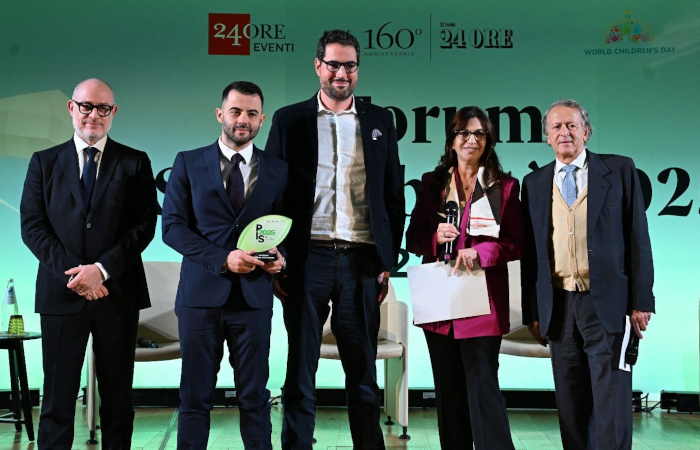
On 22 October, as part of the Sustainability Forum, the The INFN Radiantis Research spin-off was awarded the Sustainable Enterprise Award, which is awarded by Sole 24 Ore to small and medium-sized enterprises that have embarked on responsible growth paths, capable of combining economic development with environmental and social sustainability. Projects that generate value in the long term, satisfying the needs of the present without compromising those of future generations.
We took the opportunity to interview Francesco Collamati, First Researcher at INFN Rome 1 and co-founder of Radiantis Research and one of the creators of the technology behind the company.
Good morning Francesco, congratulations for the award and thanks for your availability. Let's get straight to the heart: tell us about your spin-off, what it does, when it was founded, what is the technology behind it?
Radiantis Research S.r.l. was founded in Milan in November 2023, while recognition as a spin-off of INFN occurred shortly after. It is a startup that deals with medical devices and was founded by four partners: me, a surgeon and a nuclear doctor of the European Institute of Oncology (opens in a new window) (IEO) of Milan and a fourth partner who comes from the world of pharmaceutical companies and is a biomedical engineer of training. The idea behind this is to bring to the market, after a process of industrialisation and CE marking, the device that INFN has developed in collaboration with La Sapienza University since 2012.
It is a particle detection probe to be used during surgery: the cancer patient is normally injected with a radiopharmaceutical that concentrates in the tumour to be removed. During the operation, the surgeon holds our probe, which is sensitive to the radiopharmaceutical, and is therefore guided in the complete removal of the tumour, even those parts that may not be visible to the naked eye.
In fact, ours is the only device in the world that allows radioguided surgery with PET drugs, and therefore typically have already obtained clinical approval and are commonly used by any nuclear medicine. All other systems, which are sensitive to gamma photons, have only been tested with experimental drugs and have given lower results than ours.
How did you protect intellectual property?
Technology is covered by a patent, filed by INFN in co-ownership with La Sapienza University, of which Radiantis has acquired the exclusive use licence. In addition, we have acquired, also from INFN, a license for the Know-How developed in recent years.
Starting from this knowledge and technology package, what is your first goal?
Currently, we are focused on manufacturing our probe industrially, albeit on a small scale. Over the past year and a half, we have done an enormous amount of work to understand how the process for certifying our product works. We proceeded on two fronts: on the one hand, we contacted a number of companies that could manufacture the object; on the other hand, we are creating a network of relationships, with doctors and institutions that can test the device before the CE marking, within the trials planned to obtain it. And it is precisely this second point that presents non-trivial difficulties, because it is necessary to overcome the reluctance of hospitals to authorise the testing of an entirely new product, made between a start-up and not a multinational in the sector.
In the meantime, during this journey, we have inserted two new members. The first comes from a completely different reality from the scientific medical one: he is a communication expert who met us at an event and was so impressed by our product that he decided to acquire stakes with his own personal capital. The second, on the other hand, is a consultant who helped us draw up the business plan by working with a contract of work for equity. To date we are therefore six partners.
You, as well as one of the founders, are the scientific and technological soul of Radiantis, and your role obviously derives from your experience at INFN. Can you tell us about it?
I have followed the typical path of particle physics, even if already from the bachelor's degree and then from the master's degree I have always worked on applications of physics in the medical field. Initially, I dealt with dosimetric aspects for thehadrontherapy (opens in a new window), an aspect very close to particle physics, then, at the beginning of my doctorate, Professor Faccini had the idea of developing a probe for radio-guided surgery. It was an embryonic intuition but right: we particle physicists have learned to make detectors that are very sensitive to electrons and very transparent to photons, what can we do? Where can we apply them? And this was my doctoral thesis project. Later, I worked for a year in Sapienza on topics of medical physics and then, out of necessity, I took care of other things for a year. Returning to the INFN in Rome 1 in 2017, I resumed the ranks of what I started with my doctorate, dividing my time between medical and fundamental physics.
And when did the idea of the spin-off come about?
I must be honest and admit that it was not born of me: I, as a researcher, was already satisfied with the publications we had made and with the practical demonstration on the first patient. The push for the spin-off was born precisely from the co-founders of Milan, in particular from the surgeon who had tested the probe on about ten patients and found it so useful that he said he no longer wanted to ‘operate without’. It was therefore he, together with his fellow nuclear doctor, who proposed to take the field personally to market the probe. Then I introduced myself to INFN’s Technology Transfer Service with the idea of setting up a spin-off.
This brings me to the next question, i.e. how do you assess the interaction with INFN Technology Transfer during the spin-off creation process?
I recall the enthusiasm of Ilaria (Giammarioli, head of the Technology Transfer Service, Editor’s note) when I told her that I wanted to found a start-up that would be recognised as an INFN spin-off: she told me that it was a very good idea and that we had to try to protect the technology with a patent because it gives substance to the business idea. I believe that the whole process has been a beautiful story of common interests, of INFN, myself and my medical colleagues, who from the beginning wanted to work with all the transparency and spirit of collaboration possible.
Within the TT Service I have always found infinity of availability and high competence, of course there is a bit of bureaucracy to be carried out, but in my experience the mechanisms are there and work great.
What were the biggest challenges you faced?
The first is to give some concreteness: we have done a great job behind the scenes, previous trials of the technology have aroused great interest from clinicians, but now we need a finished, industrialized and certified object. And this point is the real challenge today for this project: we are a small reality in a world of big fish and we can not afford to invest millions of euros for sponsored studies aimed at obtaining certifications, we must earn the trust of decision-makers in hospitals, find some center that can convince the ethics committee to authorize experimentation, according to the provisions of the legislation. That is why we would like to emphasise that we are INFN spin-offs, to show that Radiantis has a solid scientific and technological base behind it.
The other challenge was to navigate the world of certification of a medical device, because very broad skills are required, which, in fact, do not exist in single subjects. And this is also my suggestion for INFN: if there is a real interest in making applications and devices in medical physics, it would be very useful to have some form of consultant who can help in the field of certification.
Instead, the greatest satisfaction?
I must admit that receiving the payment of the new partner who wanted to enter with his capital has had a certain effect: to see that something that was born with my doctoral thesis, with ideas written on a blackboard has evolved to the point that not only has it impacted the lives of about forty patients, but someone has decided to invest a certain amount of money out of his own pocket because he believes in the project.
So what are the next steps?
First of all, small-scale industrial production so as to have the first pieces to be given free trial to a certain number of surgeons, possibly also providing for "subscription" proposals, in which in addition to the probe and its maintenance, we provide training and advice in the drafting of medical protocols.
Last question: how do you see yourself in the future, researcher or entrepreneur?
I do not see myself as a big manager and I would like to maintain my position as a researcher but I would not mind continuing to deal with Radiantis, perhaps as a consultant, even in the event that the company is acquired by a larger company. I have helped to create this device and I wish I could continue to follow its future developments.
Thank you, Francesco, and again congratulations for the award.
Thanks to you.
Find out more:
the spin-off INFN
the Site Radiantis Research
News
Read also
More news from INFN Technology Transfer.
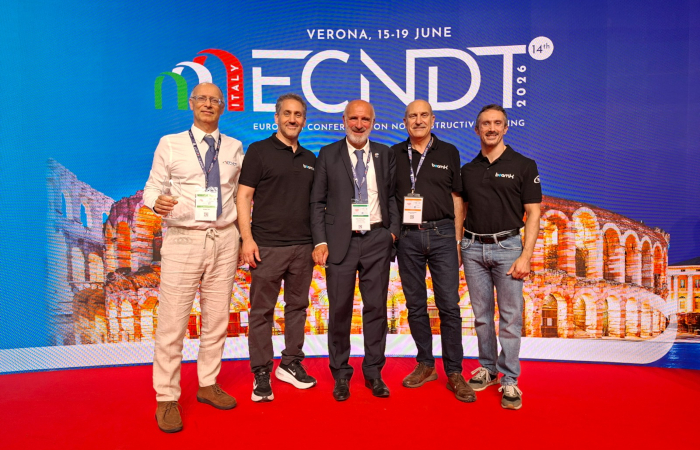
BeamX: when a market need stimulates the creation of a spin-off
The INFN BeamX spin-off produces industrial particle accelerators, we talk about this with David Alesini and Luigi Faillace, researchers at INFN’s Frascati National Laboratories and co-founders of the company
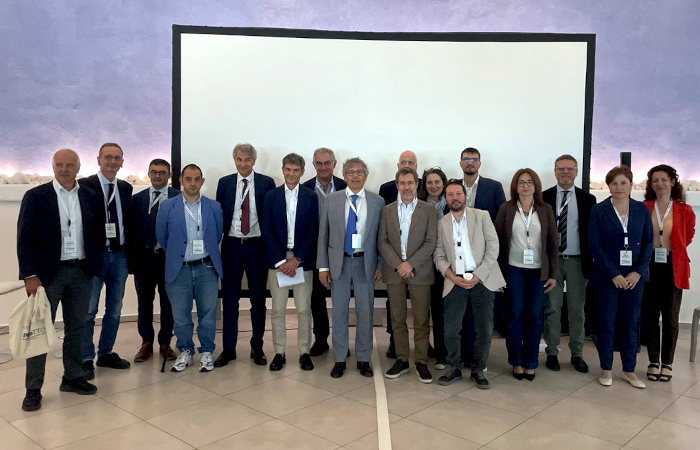
INFN at the ‘PerfeTTO meets Puglia’ event
On 11 and 12 June, the PerfeTTO meets Puglia event was held in Monopoli, where research bodies, universities, institutions and companies launched a debate to strengthen the ecosystem of innovation and technology transfer in the Life Sciences.
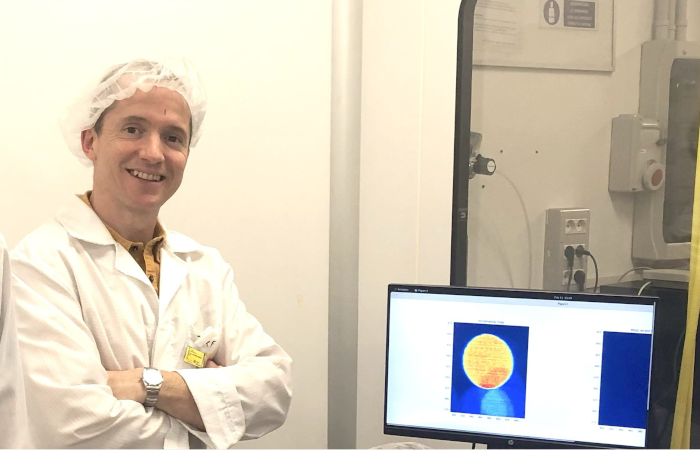
Stay close to the tools: why technological proximity is the key to technology transfer to INFN
The point of view of Manuel Rollo, INFN researcher and member of the National Committee for Technology Transfer
Contact us
Want to collaborate with INFN?
Tell us about your need: the TT Service puts you in touch with the right people and skills for your project.
Contact us