




Spin-off
Interview with Andrea Chincarini, researcher at INFN in Genoa and co-founder of Dorian Technologies
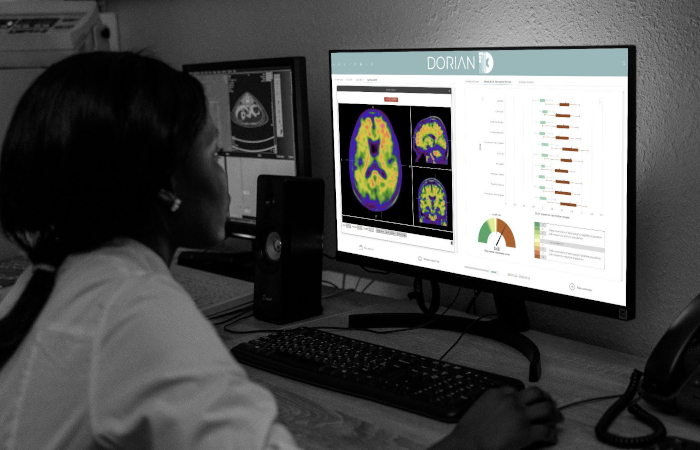
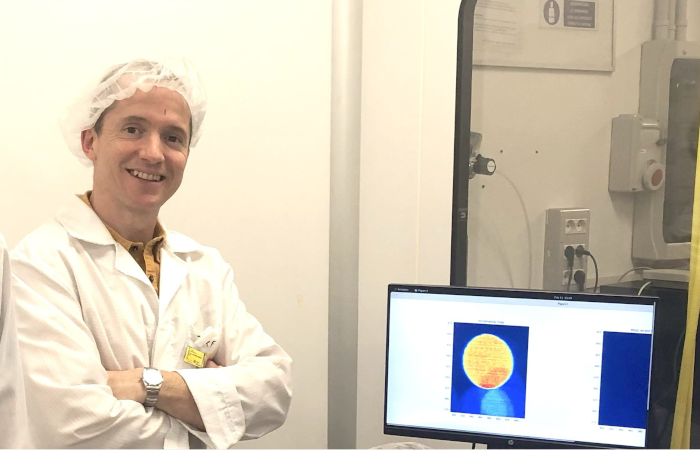
We interview Andrea Chincarini, first researcher at the Genoa section and co-founder of Dorian Technologies, one of the first spin-offs recognised by INFN, born as an innovative start-up in 2020.
The company’s mission is to unlock the potential of quantitative imaging and artificial intelligence to optimise the diagnosis, prognosis and monitoring of patients, focusing in particular on those with Alzheimer’s, Parkinson’s and other neurological diseases.
Hello Andrea and thank you for your availability. First, tell us something about yourself and your work.
I am the first researcher at INFN in Genoa, I have always been involved in data analysis and in 2004, thanks also to the contribution of Sandro Squarcia, a professor at the University of Genoa who introduced me to this field, I started working on data analysis in the medical field. At that time we started talking about machine learning and advanced data analysis applied to medicine, we started working on large databases and I embarked on a research path that continues even now and has been funded with various INFN experiments. As part of this R&D process, which has lasted for more than 20 years, we have specialised in analysing data on the brain and its pathologies, in particular on degenerative diseases that are still difficult to diagnose. In discussions with our medical colleagues, with whom we collaborated and continue to collaborate, we found that the technologies we were developing could also have a potential commercial impact, in the sense that they were technologies that were needed, so clinicians put a lot of pressure on us. From there were born some patents and the line of research that led to the creation of Dorian in 2020.
How was Dorian born?
The spin-off was born after the patents we filed, also on the recommendation of our clinical colleagues, and began with a group of willing guys who had just graduated or had obtained a doctorate in this field, and decided together with me to be partners in this adventure. In the early years it was very difficult, because the transition from idea to commercial product is much more difficult than we thought, that famous “last mile” which is actually rumored to be almost a hundred miles. In our field, then, to be commercially relevant you need to be certified, which requires a lot of knowledge that goes beyond the scientific field and a considerable investment of time and money.
Can you describe in simple words the technology behind the spin-off?
Dorian develops quantitative methods for data analysis. Today, some would like to believe that artificial intelligence can replace the clinician: enter the data into the system, turn the crank and artificial intelligence tells you what you are and what diseases you will have. I don't believe in this approach, not because it technically can't be done, but because I don't find it ethically correct. Instead I deeply believe that these systems, artificial intelligence, machine learning, etc. can help the clinician in deriving a whole series of information from complex data. The path we have chosen to follow in the creation of the spin-off is precisely this: to use analysis systems to extract quantitative data pertinent to a certain pathology that can help the doctor in clinical practice.
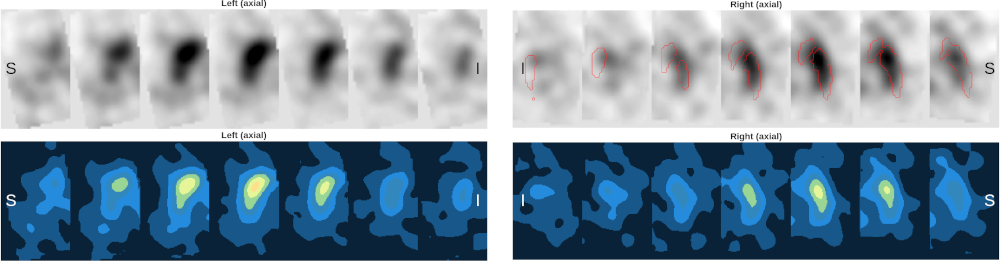
To do this, we have developed a whole series of analysis ‘pipelines’, i.e. advanced statistics and artificial intelligence tools that are pre-packaged and dedicated to answering specific clinical questions. Our focus is that of nuclear medicine because it is the one closest to our preparation.
What is your role within the company?
I am one of the founders, and formally Chief Scientific Officer. I have never held the position of CEO because from the beginning the idea was that the guys who founded Dorian together with me would lead the company; I am a ‘great noble father’, but they are the people who really work there full-time.
How has the company changed and your role within it since its foundation?
At the beginning it was just us six founding partners, now we have hired an employee and we have another contractual person, plus various consultants; more people revolve around the company. I continue to deal with the scientific part, the development of new technologies. I prefer not to deal with fundraising, that is a different job from mine, which requires another type of mentality.
Given the difficulties you mentioned, why did you come up with the idea of starting a spin-off? It's not something everyone thinks about.
I started thinking about a spin-off already in 2018 and it took many years because our initial approach was that of the scientists who went to ask for funds for an experiment and consequently we were ignored because we had no structure and no economic-financial knowledge.
Despite this, the fact that there was a need for a spin-off was something easily understood. Already in 2014-15 the first large structured databases of medical data, not only local, but also of international level, began to be born. On the medical side it was understood, and this was perhaps the great paradigm shift, that it was necessary to do data analysis and advanced statistics on medical data to be able to guess certain pathological mechanisms that otherwise with clinical experience alone could not be understood. The clinical contacts we had as part of the research projects in which we participated strongly pushed us to create a business reality that could become a point of reference. We established ourselves at the end of 2020 and we were already late, we should have done it earlier, but we did not have the tools and the ability to manage a product, because having the idea is not enough, to complete it we need administrative knowledge, we need to know the world related to quality management. And capital is needed.
Yours was one of the first spin-offs recognised by INFN so, in a sense, the Institute was also implementing new working procedures and methodologies. How things went and what you suggest for the future.
Creating a business is really complex, especially in the medical field where there are many regulators to know and respect. The sharing of objectives between the Institute and spin-offs is crucial, however, as often happens to those who venture into contexts not yet consolidated, some critical issues have emerged due to the lack of operational guidance, a structured network of qualified consultants and reliable investors, key elements to support those who undertake an entrepreneurial path. The difficulties encountered in the early stages, as in our case, highlight the need to strengthen the accompanying mechanisms. Building on the experience, if I may make a suggestion, it would be useful for INFN to create dedicated support tools, such as lists of advisors and mentoring pathways, in order to facilitate the emergence and development of future business initiatives.
Thank you for your point of view and, indeed, it is in this direction that the Institute has moved in recent years. Returning to your entrepreneurial path, what was, instead, the biggest challenge?
Surely the raising of capital, especially because we deal with medicine, a world in which competition is made up of big realities and where everything costs a lot. There are mandatory consultations, certifications and everything is very expensive. We, in order to reach a minimum of capitalization that would allow us to continue, suffered a lot.
And instead, after 5 years, satisfaction?
Satisfaction is that we have found the capitals, we have an office, new staff, we have structured ourselves; Now we also have a partnership with a large pharmaceutical company and we are growing. Soon we will arrive at our first certified product and from there it should go a little further downhill.
So if you were to think of a significant event in the spin-off path, what would it be?
Surely the certification of our first product, because reaching this point means having collected at least €500,000 in funding and keeping this activity alive even when funding was lacking.
What will be the next steps?
They are already well determined because we have received extra funding to certify the second product, so we will have to move on to do that. Subsequently, we should contact larger industrial companies than us, typically manufacturers of machines or drugs, to integrate our software into their products; We already have such an agreement, but we need to expand it.
Then, after CE certification, we need to get that FDA in order to enter the US market. And then, of course, there is China.
Last question: how do you see yourself in the future, more scientist or entrepreneur?
I remain a scientist, because I have understood that the entrepreneur is not my way, the approach is foreign to my thinking. Also because to be successful in this branch you have to have a strong foot in medical research and I have the contacts that serve to make a contribution of this kind.
Find out more:
the spin-off INFN
the Site Dorian Technologies (opens in a new window)
News
Read also
More news from INFN Technology Transfer.
BeamX: when a market need stimulates the creation of a spin-off
The INFN BeamX spin-off produces industrial particle accelerators, we talk about this with David Alesini and Luigi Faillace, researchers at INFN’s Frascati National Laboratories and co-founders of the company
INFN at the ‘PerfeTTO meets Puglia’ event
On 11 and 12 June, the PerfeTTO meets Puglia event was held in Monopoli, where research bodies, universities, institutions and companies launched a debate to strengthen the ecosystem of innovation and technology transfer in the Life Sciences.
Stay close to the tools: why technological proximity is the key to technology transfer to INFN
The point of view of Manuel Rollo, INFN researcher and member of the National Committee for Technology Transfer
Contact us
Want to collaborate with INFN?
Tell us about your need: the TT Service puts you in touch with the right people and skills for your project.
Contact us