




Insights
Open science and protection of intellectual property in research institutions

GenOA Week 2025, the annual open science conference, provided an opportunity to discuss the relationship between intellectual property and open access to research products.
“Intellectual property is thought to be a brake on the free movement of knowledge, but this is an erroneous statement”, says Diego Tonini, who spoke at the conference representing INFN’s technology transfer. “Intellectual property tools, if used correctly, allow knowledge to be managed, guaranteeing recognition of authorship and its origin, without limiting its dissemination.”
An example in this sense are patents: by filing a patent application you agree to make your invention public in all the salient details. After filing, anyone can access the text of the patent free of charge and use the invention for personal or research purposes. What the patent prevents is, for a limited period of time, the commercial exploitation of the invention without the consent of the holder of the rights.
‘Let’s not forget that a patent can act as a driving force for private innovation’, continues Tonini, ‘ensuring the possibility of exclusively exploiting an invention gives companies the incentive to invest time and resources in industrial development, knowing that the results will then lead to a competitive advantage and, ultimately, an economic return.’
Similarly, copyrights in research products, such as scientific articles, data representations and software, should be considered.
“The purpose of INFN is not to monetise its scientific results at all costs; Freedom of research, cooperation and sharing are the priority of the Institute. What the Technology Transfer Service and the Open Science Working Group are trying to do is to ensure that the work of research staff and INFN is properly recognised, ensuring that third parties do not take ownership of it.”
Software distribution is an emblematic case: thousands of lines of code are written in INFN, programs developed for scientific computing, data acquisition and data processing, which can also be useful for colleagues from other institutions or find applications in completely different areas from the one for which they were created. Often, all this wealth of knowledge is forgotten on some hard drive or distributed extemporaneously, without a proper license, with the risk that its potential benefit to society will not be fully expressed or that someone will misuse it without paying due credit to the authors and INFN.”
“Applying the correct software license meets different needs”, says Francesco Giacomini, IT technologist at CNAF INFN in his speech, “first of all allowing the sharing of software for scientific and technological research purposes, but also encouraging the transfer of knowledge and technology to society, with two connotations: the recognition of what INFN has produced and the possibility of its economic exploitation.
For this reason, work is underway to ensure that all code developed and made public by INFN is released under the appropriate licence, favouring those that are available whenever possible. open source reciprocal such as the EUPL (opens in a new window), developed by the European Union and also available in Italian, in order to comply with the principles ofopenness’ They have always driven science, while preventing the appropriation or closure of derived and redistributed products.
In a public research body, Open Science and Intellectual Property, although different and apparently irreconcilable, coexist and operate, each with its own tools, for the common purpose of advancing knowledge.
News
Read also
More news from INFN Technology Transfer.
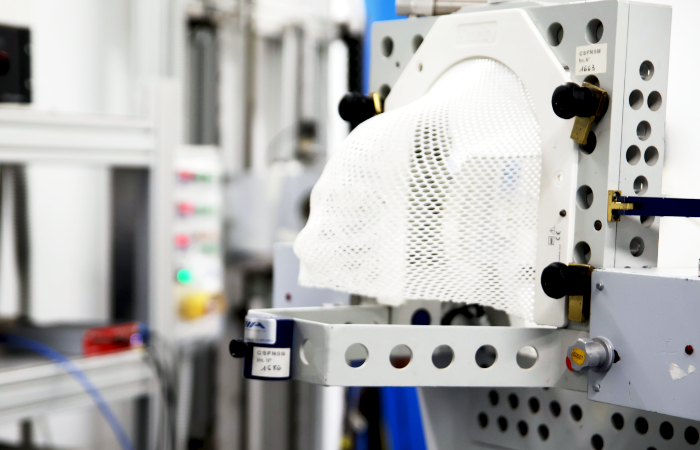
Particle accelerators at the service of society
If you think of a particle accelerator, great equipment comes to mind in laboratories dedicated to scientific research. The role of these machines in the study of basic science is certainly very important, however, they are also used for purposes closer to everyday life. Among the different applications of accelerators, the most significant are probably those related to medicine and cancer treatment.
L as Lead
To reach the market, a technology born in the laboratory needs to be accompanied along a path that goes from identifying its application potential to valorisation, through constant monitoring and support. This is the role that the INFN Technology Transfer Service, together with the National Committee for Technology Transfer (CNTT) and the network of local representatives plays every day, that is to act as a lead, a guide, between basic physics and the productive world. Lead is a structured process that connects laboratories, researchers, companies, investors and institutions to transform skills and knowledge into concrete innovation capable of generating value for society.
From Laboratory to Patient: The Role of INFN Technology Transfer in Life Sciences
From laboratory to patient: the role of INFN Technology Transfer in medical physics The point of view of Mariangela Cestelli Guidi, coordinator of INFN's National Committee for Technology Transfer
Contact us
Want to collaborate with INFN?
Tell us about your need: the TT Service puts you in touch with the right people and skills for your project.
Contact us