




Events
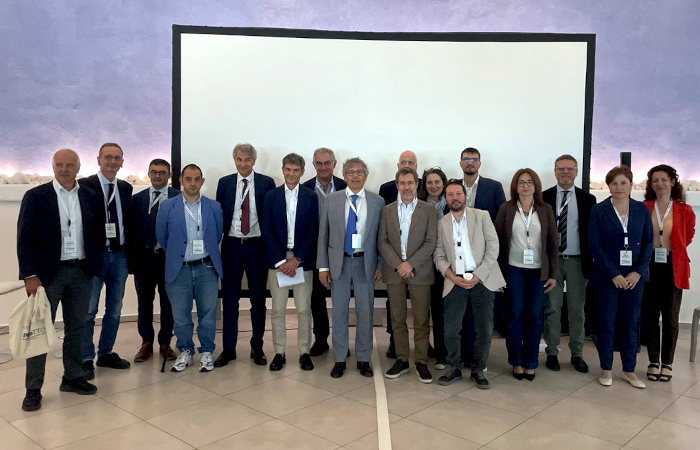
KM3NeT4RR: the final event of the NRRP project between industry, institutions and excellent research in Catania
The meeting was a moment of synthesis not only of the scientific results achieved but also of the significant impact generated by the project on the entrepreneurial fabric.
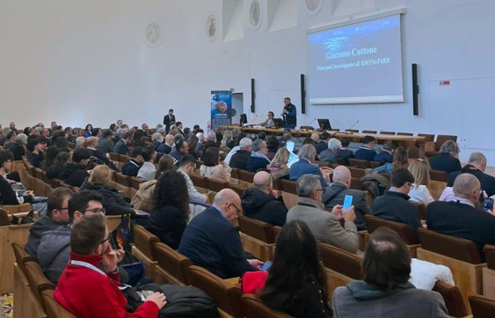
The meeting was a moment of synthesis not only of the scientific results achieved but also of the significant impact generated by the project on the entrepreneurial fabric.
The final event was held on 23 February 2026 at the Benedictine Monastery of San Nicolò l’Arena (Catania). KM3NeT4RR, the project financed by the National Recovery and Resilience Plan (NRRP) which strengthened the submarine infrastructure of KM3NeT, one of the most advanced neutrino observatories in the world.
High-tech companies at the centre of the event
A distinctive feature of the event was the presence of high-tech suppliers for the construction of submarine infrastructure: the project managed purchase orders with highly specialised technological content for tens of millions of euros.
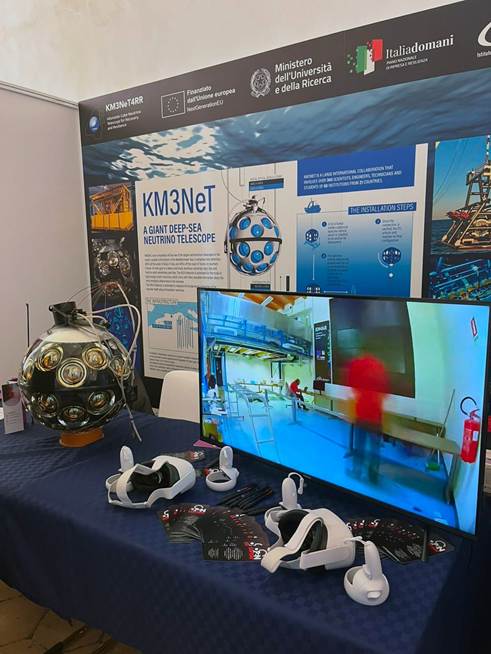
The companies animated with their exhibits the ‘Clock Corridor’, an exhibition space that allowed participants to explore engineering solutions, advanced components, optical and electronic systems developed to operate thousands of meters deep off Capo Passero, in Sicily.
The role of the supplying companies was highlighted during the presentations of the Work Package project leaders who illustrated, each for its scope, positive experiences of co-development between research and business which have combined experience and know-how that are complementary and at the same time indispensable for the achievement of the result.
KM3NeT4RR has in fact activated high-tech supply chains, consolidating industrial skills that can also be transferred to other sectors, from offshore to advanced electronics, to mechanics and precision sensors.
From procurement to communication: the keys to success
The round tables highlighted some key factors for the success of the project.
Particular attention was paid to the procurement procedures of the Public Administration and to the best practices implemented with the NRRP: the competent management of public tenders was essential to support large research infrastructures, encourage the qualified participation of companies and above all compliance with project times.
Alongside this, the importance of communication in making visible the impact of basic research on society and the economy, on the territory but not only, has strongly emerged. Telling the technological complexity of an observatory that, from the bottom of the sea, intercepts signals from the most energetic cosmic events, means strengthening awareness of the value of public investments in basic research.
Finally, the role of project management has been recognized as a central element in the coordination between scientific, industrial and administrative activities, in an articulated international framework and in compliance with the NRRP milestones.
The strong support of the institutions
The institutional participation It was surprisingly heartfelt and sincere, a sign of awareness of the strategic potential of the infrastructure. An observatory capable of exploring the Universe from the depths of the abyss is a powerful symbol of the country’s ability to combine scientific excellence, technological innovation and industrial development.
‘From the depths of the abyss to the Universe’ effectively summarises the spirit of the project: a bridge between fundamental research and applications with a very high technological content, between the territory and the global scientific community.
A piece of a long-term scientific path
KM3NeT4RR is part of a research path started for years within the KM3NeT infrastructure and its predecessors, strengthening its capacities thanks to NRRP funding. Not a point of arrival, therefore, but a fundamental stage of a scientific trajectory already consolidated and projected towards new challenges.
The Catania event confirmed that large research infrastructures can be drivers of innovation and growth, capable of activating industrial skills, generating frontier knowledge and enhancing the strategic role of collaboration between public research, companies and institutions.
“KM3NeT4RR has shown how a large research infrastructure can grow thanks to an integrated vision that combines scientific excellence, management soundness and institutional cooperation capacity”, he stressed. Giacomo Cuttone, head of research at INFN’s Southern National Laboratories and principal investigator of the project. “The study of cosmic neutrinos represents one of the most advanced frontiers of contemporary physics, offering a unique interpretation of the most energetic and remote astrophysical phenomena occurring in the cosmos. We are opening a new chapter in our deep understanding of our universe, from which we will extract important information to find answers to great questions, such as those about its origin and destiny", concludes Cuttone.
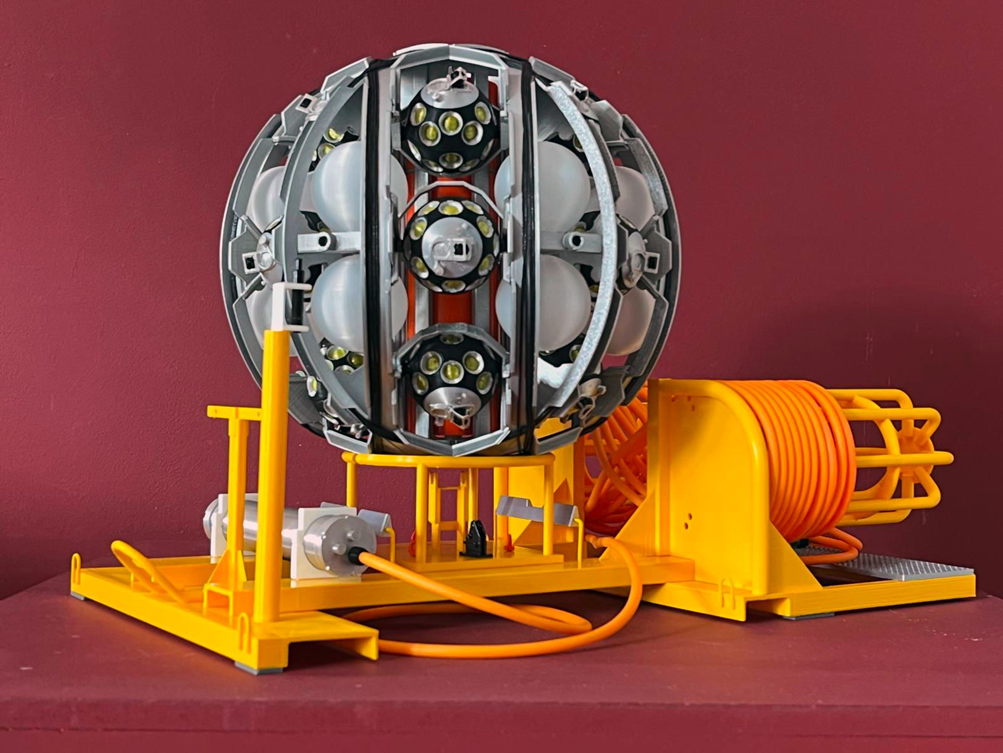
KM3NeT (Cubic Kilometre Neutrino Telescope) is a European research infrastructure located on the seabed of the Mediterranean Sea. It houses Čherenkov-type underwater telescopes, designed to detect and study neutrinos from distant astrophysical sources but also from our atmosphere.
Grids composed of thousands of optical modules detect the faint Čherenkov light produced by charged particles generated in neutrino interactions with water near the detector. The position, the direction of the optical modules and the time of arrival of the light on the photomultipliers inside them allow to reconstruct the trajectories of the revealed particles.
The KM3NeT project involves the construction of multiple detectors in the depths of the Mediterranean Sea. Off Toulon, France, the KM3NeT-Fr site hosts the ORCA (Oscillation Research with Cosmics in the Abyss) detector, while off Portopalo di Capo Passero in Sicily, Italy the KM3NeT-It site hosts the ARCA (Astroparticle Research with Cosmics in the Abyss) detector.
Recently, ARCA detected the most energetic neutrino ever observed (KM3NeT reveals record-breaking neutrino – National Institute of Nuclear Physics).
Find out more
News
Read also
More news from INFN Technology Transfer.
SHARPER 2026: In L’Aquila, the European Researchers’ Night is enriched by a space dedicated to INFN technology transfer
Thanks to the OPEN.INFN2 project, the 2026 edition, presented at Palazzo Margherita, will host a space dedicated to technology transfer and dialogue with businesses, schools and citizens Science leaves the laboratories and meets the city: this is the spirit of SHARPER – European Researchers’ Night, which returns to L’Aquila on Friday 25 September 2026 with a day full of events, experiences and opportunities for discussion dedicated to citizens of all ages. The event, supported by Fondi Restart – Sviluppo delle Potenti culturali del Comune dell’Aquila (Restart Funds – Development of the cultural potential of the Municipality of L’Aquila), is part of L’Aquila’s 2026 Italian Capital of Culture programme, supported and promoted by the Municipality of L’Aquila.

From Laboratory to Patient: The Role of INFN Technology Transfer in Life Sciences
From laboratory to patient: the role of INFN Technology Transfer in medical physics The point of view of Mariangela Cestelli Guidi, coordinator of INFN's National Committee for Technology Transfer
INFN at the ‘PerfeTTO meets Puglia’ event
On 11 and 12 June, the PerfeTTO meets Puglia event was held in Monopoli, where research bodies, universities, institutions and companies launched a debate to strengthen the ecosystem of innovation and technology transfer in the Life Sciences.
Contact us
Want to collaborate with INFN?
Tell us about your need: the TT Service puts you in touch with the right people and skills for your project.
Contact us