




Technologies
Demonstrated use of perovskite monocrystals as high energy charged particle tracers
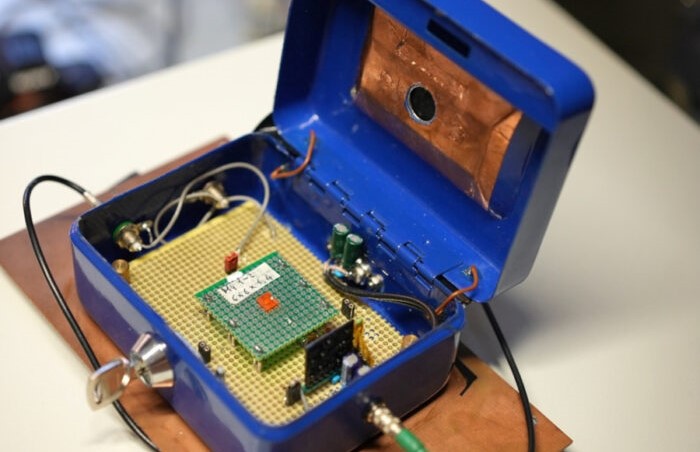
For the first time a single perovskite crystal has been used to detect and trace charged particles at high energy.
The result, obtained as part of INFN’s PEROV experiment and published in the journal NANOSCALE (opens in a new window), is part of the strategy to enhance the technology of manufacturing perovskite monocrystals and their use as particle tracers, which has been developed with the PoC project MICROPEROV (opens in a new window), which aims to increase the TRL of the patent (opens in a new window) held jointly by INFN and CNR. A further patent INFN protects the exploitation of the material as a particle tracer.
The test was conducted using the Beam-Test Facility of the Frascati National Laboratories and verified that the material is sensitive to single high-energy electrons, also demonstrating its potential use for the dosimetry of high-intensity charged particle beams, such as those used in the medical field in FLASH therapy, currently being studied for the treatment of some cancers.
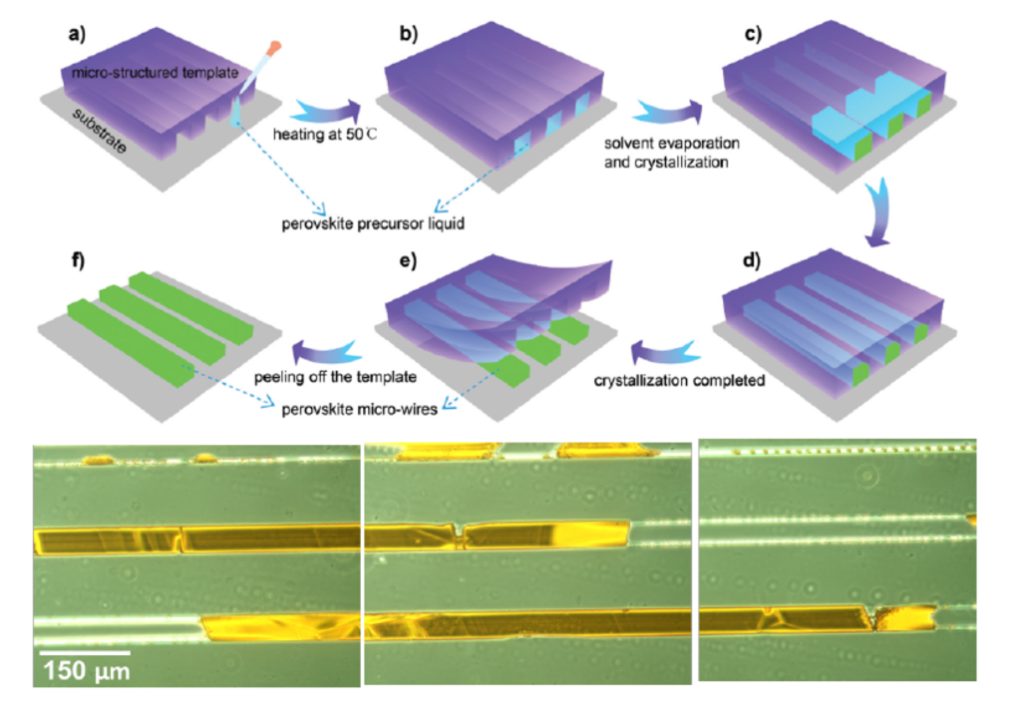
Perovskites are a class of materials with a specific crystalline structure, which have risen to prominence in recent years for possible applications in the creation of photovoltaic cells or in the creation of sensors. The particular perovskite used in this study has formula MAPbBr3 It is an organic-oinorganic hybrid smicondttore already known for its X-ray refining properties. Unlike traditional semiconductors, however, the material is produced at room temperature through a patented microfluidic technique, which allows individual crystals to grow on flexible or structured substrates, for example directly above a chip, creating an integrated sensor-electron system.
The detection properties of this material, combined with its ability to self-heal after exposure to radiation, make it an excellent candidate for the creation of particle tracers for medical and scientific use.
News
Read also
More news from INFN Technology Transfer.
INFN technology allows the first production of copper-67 in Italy
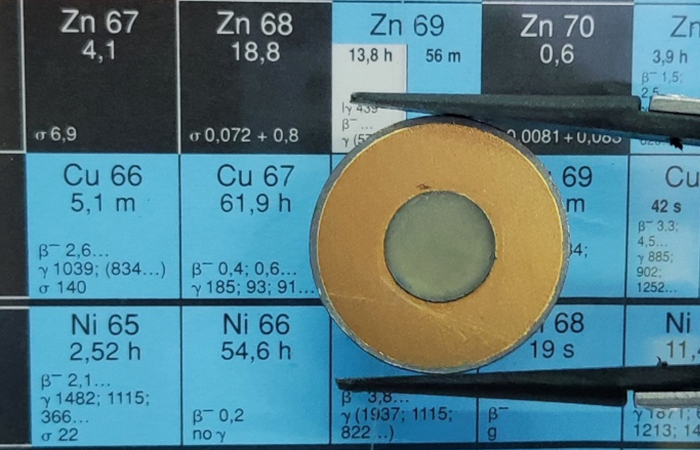
The collaboration between the National Laboratories of Legnaro of INFN, the University of Ferrara and the IRCCS Sacro Cuore Don Calabria of Negrar (VR) has reached an important milestone for Italian nuclear medicine, opening new perspectives for the national production of teranostic radionuclides: the first production, in our country, of copper-67 (67Cu), one of the most promising radionuclides for the diagnosis and treatment of various oncological diseases.
Particle accelerators at the service of society
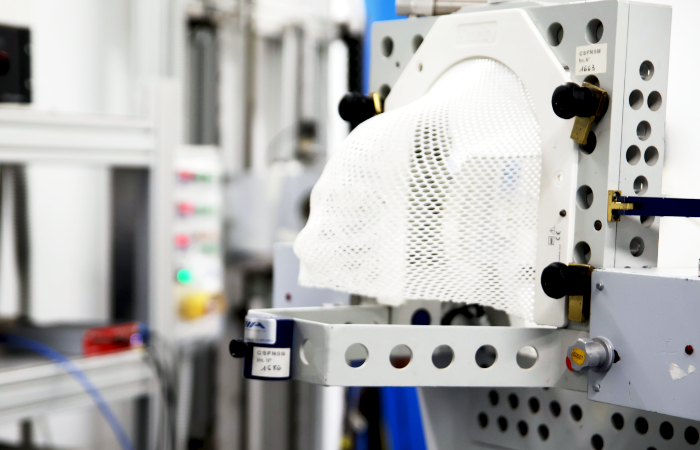
If you think of a particle accelerator, great equipment comes to mind in laboratories dedicated to scientific research. The role of these machines in the study of basic science is certainly very important, however, they are also used for purposes closer to everyday life. Among the different applications of accelerators, the most significant are probably those related to medicine and cancer treatment.
New frontiers in X-ray computed tomography for patient diagnosis and treatment
Antonio Sarno, researcher of the INFN section in Milan, works to make X-ray tomography with a conical beam more and more accurate.
Contact us
Want to collaborate with INFN?
Tell us about your need: the TT Service puts you in touch with the right people and skills for your project.
Contact us