




Spin-off
Interview with the founders of MuonLab
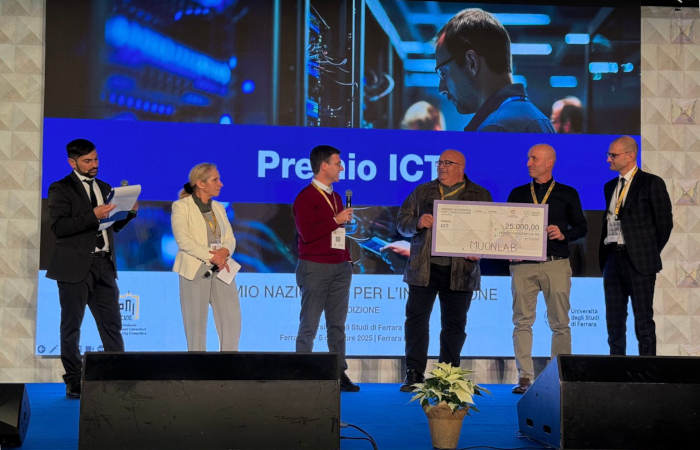
We interview the four founders of MuonLab: Lorenzo Bonechi, researcher of the Florence Section and Roberto Ciaranfi, technician at the same Chamber; e Vitaliano Ciulli e Raphael D’Alessandro, full professors at the University of Florence and INFN associates.
Tell us what MuonLab is and what it does
MuonLab is an innovative startup and spin-off of INFN e University of Florence It was officially established in July 2025. Provides services of imaging 2D and 3D through the Muon X-ray, a technology that we have studied and developed as part of our research activities at INFN and universities.
Last December, with MuonLab, you won the first prize in the ICT category at the National Innovation Award, together with the special awards SearchOn We Make Future and Venture CDP, tell us how it went.
Lorenzo: MuonLab is a spin-off of both INFN and the University of Florence, and thanks to the University we have been involved in the Start Cup Tuscany Region. The event took place shortly after the creation of the spin-off, which was in July 2025, and thus was an excellent opportunity to introduce the company to a wider audience.
Raphael: we passed a first selection based on business plan submitted, obtaining access to the regional final, which took place in Pisa, during which we presented a pitch Five minutes. We won the Special Prize of the Addì Society and we ranked fourth overall, guaranteeing a place for the national final that took place in Ferrara. The pitch for Ferrara it had to be further reduced to 3 minutes and I must say that we did a good job, although it was rather difficult to explain in such a short time to a non-expert audience what muography is.
Lorenzo: Beyond the awards, which obviously gave us great pleasure, I would like to underline that after the presentation in Ferrara we received many compliments from both investors and jurors of the other categories, who were not involved in the evaluation of MuonLab. We are therefore very satisfied with this experience, which we think has led to more than positive results, both for the company and for INFN and universities.
Given the experience gained in short but effective presentations, I would like to ask you to describe the technology behind MuonLab in a few words.
Lorenzo: the idea is to be able to look through large thicknesses of materials, as our vision says: see through, see inside, using as methodology the muon X-ray that is similar to what is commonly done with X-rays, but using a natural radiation that comes from cosmic phenomena and reaches the Earth. Part of this radiation is made up of elementary particles, the muons, which can penetrate the Earth's crust for hundreds of meters. By exploiting this phenomenon we are able to make x-rays of large volumes of material, such as architectural structures and mines, using the instrumentation developed by us over the years during our work as researchers, whose technology has been patented It is now licensed to MuonLab. These instruments, properly positioned, allow us to carry out, with measurements lasting a few weeks, X-rays of large structures, also measuring the average density of the materials crossed by the muons.
In the final pitch to the National Innovation Prize, you say that you have developed your technology with archaeological research in mind, but then you have moved towards mining applications, why this change of direction?
Vitaliano: Archaeology was the first application of muography, in 1970 by Nobel Prize winner Luiz Alvarez, and it is certainly the one that most fascinates the public, but from a commercial point of view, the mining sector is certainly the most promising. In this respect, we have benefited from contact with a group of geologists from both the University of Florence and the Institute of Geosciences and Georesources of the CNR of Pisa (IGG-CNR), which has allowed us to carry out a very thorough test of the Temperino mine (opens in a new window). The ideal positioning of our measuring apparatus is below the area of interest, so working on mines already open allows you to easily reveal empty areas or areas of different density than the surrounding rock, and opens up very large potentials. At this historical moment, then, mining prospecting is of great interest because, although mining activity in Italy is very limited, it has been understood, also on the basis of the raw material act of the EU, which we cannot depend on non-European countries for the supply of critical materials and therefore there are plans for the opening and reopening of mines in Italy.
There is also the aspect of sustainability: doing more targeted research thanks to your imaging system reduces the environmental impact that is never small for the mining sector.
Lorenzo: Exactly, exploration relies heavily on invasive methods such as core drilling, so the idea of replacing them, at least in the first phase of identifying areas of interest, goes precisely in the direction of a lower environmental impact.
Vitaliano: Then there is the other aspect that we are exploring, namely that of mining dams which unfortunately have a huge environmental impact and pose significant risks to the environment and the people living in the surrounding area. A non-invasive survey methodology allowing the monitoring of dams containing mining waste could therefore be a very important safety tool.
Let's go back to your story: when did you become aware of the fact that the technology behind MuonLab could have an industrial and commercial outlet in addition to research?
Lorenzo: is an awareness born quite far in time, after verifying that the test measures were of interest even outside our research groups. We received very good feedback from groups of geologists who were very impressed by our results. From that point on, it was no longer a question of carrying out research activities, but of implementing measures that required considerable resources and therefore the idea was born of setting up a company that could carry them out outside the INFN and university context.
Was there a specific moment in your history when you realised that it might make sense to start a company?
Lorenzo: I would say the experience of the Temperino mine. We were collaborating with geologists who saw the results and told us that they did not expect such a level of performance. We had already had experience in the archaeological and volcanological fields, but the mining experience made us understand the commercial potential of our technology.
Raphael: From my point of view, the trigger was when we started the pre-incubation process with the university, activities of that kind help to make a decision, in one direction or another. Similar stimuli also came with the mentoring path promoted by INFN in collaboration with Cassa Depositi e Prestiti in 2024.
How is the company structured at the moment?
Right now we are the four founders and a CEO external who has business management skills. We founders cover all the technical skills necessary for the measures, but we have contacts with young researchers who we would like to involve when they start the commercial activities of MuonLab.
How do you evaluate the support that INFN has given you for the creation of the spin-off?
Raphael: there is a uniqueness in this spin-off which is the recognition by both INFN and the University of Florence. INFN’s close cooperation with academia has yielded excellent results.
Roberto: The first step was the R4I funding that allowed us to increase the level of technological advancement of our solution, then we participated in the training course provided by the Graduate School of Management of the Politecnico di Milano (GSoM POLIMI) through the INFN-Cassa Depositi e Prestiti collaboration, which allowed us to acquire managerial skills that we did not have. INFN has therefore supported us in these two fundamental phases and has also allowed us to gain greater confidence in the goodness of our technology but also of our commercial proposal. In light of this and the first signs of interest that we are collecting, I did not feel alone, but I felt that INFN accompanied us on this adventure.
Vitaliano: As a university employee I lived the path more from that side but I found the training of GSoM POLIMI very useful, especially with regard to the tutoring part. In addition to that, all the interaction with INFN’s Technology Transfer Service, which helped us in our choices and in the way we set up our entire business, was very useful.
Lorenzo: when we thought we were ready to found the company, INFN involved us in a training and mentoring course organised with GSoM POLIMI and CDP; this has made us postpone the establishment of the spin-off by a year but has given us new tools and skills, has allowed us to realize a business plan more sustainable and a pitch more effective for presentations to investors.
What are the biggest challenges you have encountered so far?
Lorenzo: the journey was certainly not painless, for us who come from the research environment it was not easy to adapt to thinking like entrepreneurs. There were difficulties in familiarising themselves with official documents, from the interpretation of regulations to the definition of contracts. In the end, however, thanks to the collaboration with the two TTOs, we were able to create a business plan It could be presented to investors.
Roberto: For me, the biggest challenge is to move from studying the technical details to giving results to people who are not interested in the technology itself, but in what they can achieve by using it.
Vitaliano: One of the biggest difficulties for me was the management of intellectual property: doing research tends to underestimate the problem, but once you enter the business world you have to face it. This was an aspect that required the greatest number of interactions, even just to define what and how much knowledge had to be transferred to the spin-off, and with what tools. So a tip is to start thinking about these aspects as soon as possible, even when conducting basic research projects.
This is a message that the TT Service strives to convey: even those who work in research must ask themselves the question of intellectual property, not necessarily with the idea of creating a spin-off but simply recognizing that the knowledge generated by their work, when they leave the laboratory, can benefit society.
Instead, the greatest satisfaction?
Vitaliano: certainly the victory at the NIP was the biggest recognition, then any positive feedback from the outside is a stimulus and a satisfaction.
Lorenzo: personally, seeing experienced geologists who recognized how impactful our results were was the greatest satisfaction.
How do you see MuonLab in the future and where do you see yourself, more researching or more in the company?
Raphael: Our strength is that in recent years we have trained young people, so if the company grows there will already be trained people ready to board and take off MuonLab.
Again congratulations for the award and thanks for your time.[/vc_column_text][/vc_column][/vc_row][vc_row css_animation=”” row_type=”row” use_row_as_full_screen_section=”no” type=”full_width” angled_section=”no” text_align=”left” background_image_as_pattern=”without_pattern”][vc_column][vc_column_text]
Find out more
[/vc_column_text][/vc_column][/vc_row][vc_row css_animation=”” row_type=”row” use_row_as_full_screen_section=”no” type=”full_width” angled_section=”no” text_align=”left” background_image_as_pattern=”without_pattern”][vc_column][vc_column_text]Gli spin-off INFN
the website of MuonLab (opens in a new window)
The National Innovation Award (opens in a new window)
Service on MuonLab a TG3 Leonardo (opens in a new window) (min. 6:44)[/vc_column_text][/vc_column][/vc_row]
News
Read also
More news from INFN Technology Transfer.
BeamX: when a market need stimulates the creation of a spin-off
The INFN BeamX spin-off produces industrial particle accelerators, we talk about this with David Alesini and Luigi Faillace, researchers at INFN’s Frascati National Laboratories and co-founders of the company
INFN at the ‘PerfeTTO meets Puglia’ event
On 11 and 12 June, the PerfeTTO meets Puglia event was held in Monopoli, where research bodies, universities, institutions and companies launched a debate to strengthen the ecosystem of innovation and technology transfer in the Life Sciences.
Stay close to the tools: why technological proximity is the key to technology transfer to INFN
The point of view of Manuel Rollo, INFN researcher and member of the National Committee for Technology Transfer
Contact us
Want to collaborate with INFN?
Tell us about your need: the TT Service puts you in touch with the right people and skills for your project.
Contact us