




Technologies
INFN technology in COSMO-SkyMed satellites
The recently launched third satellite of the COSMO-SkyMed Second Generation constellation mounts positioning systems developed by INFN
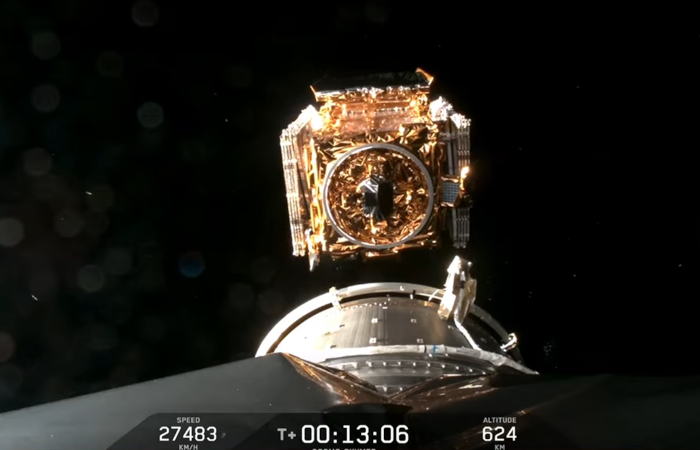
The recently launched third satellite of the COSMO-SkyMed Second Generation constellation mounts positioning systems developed by INFN
The first launch of SpaceX in 2026 was dedicated to an Italian Earth Observation satellite, whose constellation is equipped for the first time with laser retro-reflectors for orbital tracking, developed and produced by INFN.
On the night of January 3rd at 3:09 (Italian time) the third satellite of the Italian constellation COSMO-SkyMed Second Generation It was successfully launched from Vandenberg Space Force Base in California aboard a Falcon 9 spacecraft, consolidating Italy’s role as one of the world’s leading Earth observation players.
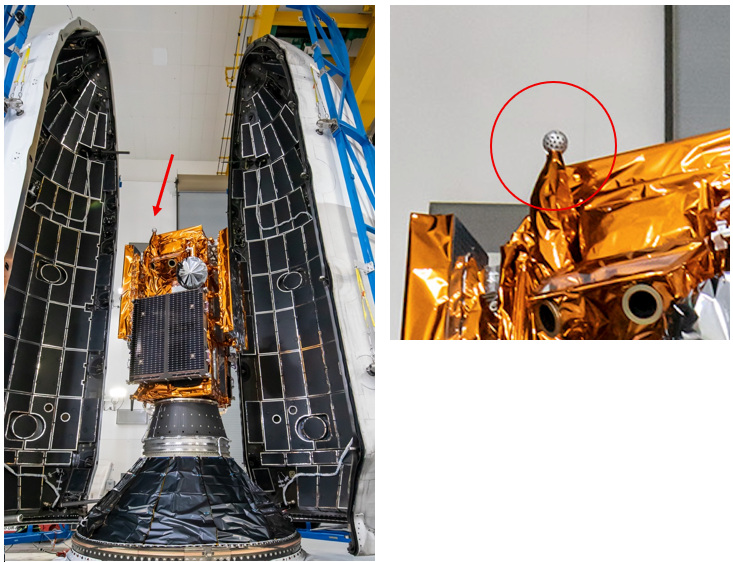
One of the innovations introduced in the satellite just put into orbit is CORA-S, COsmo-skymed laser Retroreflector Array – Sphere, developed and produced by SCF_Lab at INFN’s Frascati National Laboratories (INFN-LNF).
CORA-S is a matrix of laser retro-reflectors: a set of optical prisms that reflect the laser signals sent by ground stations (such as the Matera Laser Ranging Observatory of the ASI), which allow to measure with millimetre accuracy the distance of the satellite. The measurement accuracy resulting from CORA-S not only improves the satellite’s orbital models, but also contributes to strengthening the quality of the radar data acquired and the calibration of the on-board sensors, increasing the reliability of the observations and data generated as part of the so-called ‘georeferencing’, i.e. the determination of the absolute (as well as accurate) position of both the satellite and its valuable terrain maps, compared to the terrestrial, international and standard metric reference system.
SCF_Lab is an INFN R&D laboratory dedicated to the design, construction, characterisation and spatial qualification of laser retroreflectors installed on satellites for their precision positioning using the Satellite Laser Ranging technique, i.e. accurate measurement of the flight time of short laser pulses. SCF_Lab, coordinated by Simone Dell’Agnello, has a strong partnership with the Italian Space Agency (ASI) and collaborates with the European Space Agency (ESA), the American Space Agency (NASA), other international and national agencies and industries on missions and studies concerning the Earth and the rest of the Solar System.
The result of the collaboration between the Ministry of Defence and the Italian Space Agency (ASI), the COSMO-SkyMed Second Generation programme will be completed in 2027 with the launch of a fourth satellite. With the technological innovations introduced in the Second Generation, compared to the 4 First Generation satellites, Italy reconfirms its leading role in very high-precision terrestrial monitoring systems. These satellites, in fact, are equipped with Synthetic Aperture Radar (SAR) operating in X-band that allow to map the Earth's surface with the precision of the meter regardless of weather conditions (less than a meter in dedicated mode). The COSMO-SkyMed mission is designed to observe land, sea and coastal territory, with particular attention to the Mediterranean basin, as well as environmental and climate phenomena, to provide strategic information for security, civil protection, emergency management and environmental protection.
COSMO-SkyMed data are also distributed within the Copernicus services. The European Commission's Earth Observation Programme COSMO-SkyMed is one of the flagship missions of the Copernicus Contributing Missions. Copernicus and Galileo, Europe’s global satellite navigation system, are the European Union’s two flagship space programmes, which aim to ensure Europe’s strategic autonomy.
The development and integration of CORA-S testifies to the INFN’s ability to transfer advanced expertise gained in fundamental research to space applications with a high operational and scientific impact. The presence of this instrument on board a strategic satellite such as COSMO-SkyMed Second Generation confirms the Institute’s role as a leading player in the national and international technological landscape, capable of contributing in a concrete way to the evolution of Italian space infrastructures and European space flagships.
Find out more
Cosmo-Skymed (opens in a new window)
TheArticle by ASI (opens in a new window) on the launch
News
Read also
More news from INFN Technology Transfer.
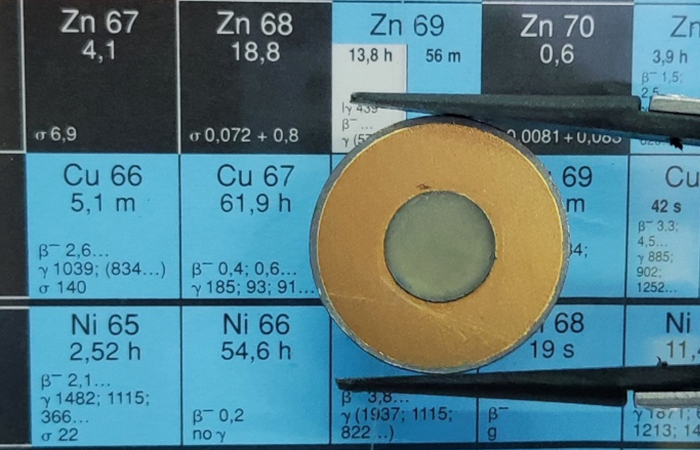
INFN technology allows the first production of copper-67 in Italy
The collaboration between the National Laboratories of Legnaro of INFN, the University of Ferrara and the IRCCS Sacro Cuore Don Calabria of Negrar (VR) has reached an important milestone for Italian nuclear medicine, opening new perspectives for the national production of teranostic radionuclides: the first production, in our country, of copper-67 (67Cu), one of the most promising radionuclides for the diagnosis and treatment of various oncological diseases.
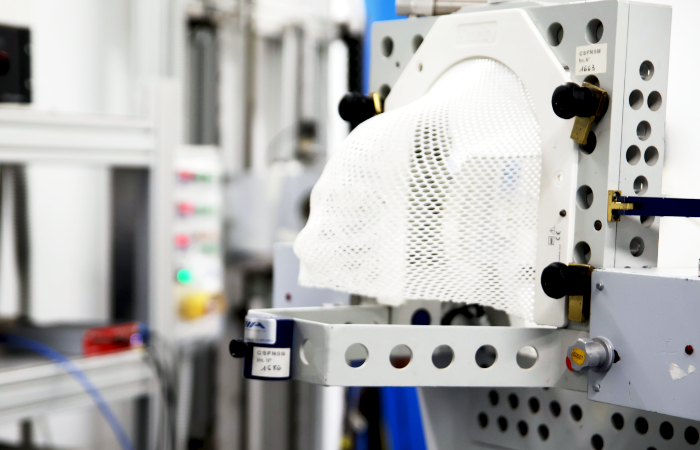
Particle accelerators at the service of society
If you think of a particle accelerator, great equipment comes to mind in laboratories dedicated to scientific research. The role of these machines in the study of basic science is certainly very important, however, they are also used for purposes closer to everyday life. Among the different applications of accelerators, the most significant are probably those related to medicine and cancer treatment.
New frontiers in X-ray computed tomography for patient diagnosis and treatment
Antonio Sarno, researcher of the INFN section in Milan, works to make X-ray tomography with a conical beam more and more accurate.
Contact us
Want to collaborate with INFN?
Tell us about your need: the TT Service puts you in touch with the right people and skills for your project.
Contact us