




Insights
From laboratory to field measurements: INFN’s commitment to radiological safety
The Laboratory for Environmental and Medical RAdiation Physics (LEMRAP) is active at INFN’s Frascati National Laboratories for the measurement of ionising radiation.
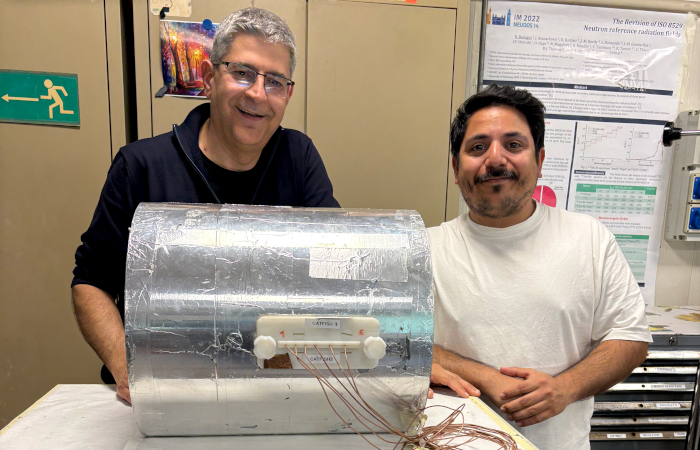
The Laboratory for Environmental and Medical RAdiation Physics (LEMRAP) is active at INFN’s Frascati National Laboratories for the measurement of ionising radiation.
Next Generation Wearable Dosimeters
Ivan Castro, a young researcher at the Frascati National Laboratories, proudly shows the latest version of the wearable neutron dosimeter DOIN, developed and patented by the LEMRAP laboratory. ‘It is smaller, lighter and easier to carry’, he says, ‘and also has a new display.’
‘We already have an improved version in the pipeline’ echoes him Roberto Bedogni, first researcher at the Frascati National Laboratories and head of the laboratory, ‘Digitech, the company we work with, has proposed redesigning the electronics to make them even more compact.’
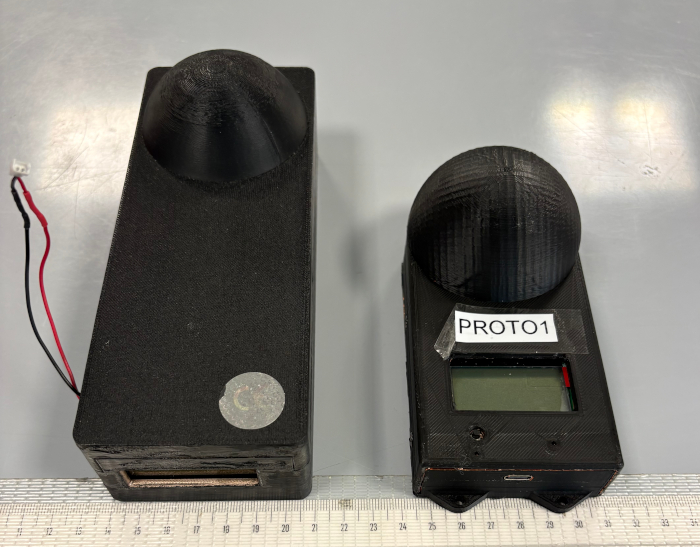
DOIN is the result of a series of R4I projects with which the INFN National Committee for Technological Transfer financed its development and subsequent improvements. “Active neutron dosimeters should meet the IEC 61526 standard, but the very few products on the market have very limited performance”, explains Bedogni, “DOIN fills this gap, in fact it meets the IEC accuracy criteria over a wide energy range and angle of incidence”.
‘We presented the dosimeter at various industry conferences, receiving good feedback and valuable suggestions’ continues Castro, ‘such as integrating a second sensor to simultaneously provide neutron and gamma-ray doses, a feature that has been added.’
"Now we just have to process the data sent to us by the test users who, at first glance, seem very positive", concludes Bedogni.
The collaboration with Digitech SRL (Peccioli, ITALY), formalised within the most recent R4I project, has made it possible to create a pre-industrial mini-series of dosimeters, distributed to some early adopter selected users who were able to use them free of charge under real-world conditions in exchange for data sharing.
The prototypes made by Digitech have been delivered to users in the field nuclear fusion (ENEA), aerospace (ITA IEAv Brazil), hadrontherapy (Clinica Universitaria de Navarra – Madrid) and fission nuclear (Bruce Power Canada), to cover interesting market segments for DOIN. Thanks to the feedback obtained it will be possible to further improve the product and program the scale up industrial.
Spectrometers for portable neutrons
The activities of LEMRAP do not stop at wearable dosimeters.
“A service that we provide and that is increasingly required of us is the characterization of neutron sources used to calibrate the instruments” says Bedogni, “which we can perform directly in situ with a spectrometer developed by us and which, compared to the traditional Bonner spheres, accelerates measurements by at least a factor of five”
The transportable system belongs to the family of single moderator spectrometers and extended energy range. It is a polyethylene moderator cylinder that includes a collimator and a series of detectors placed at different positions corresponding to different levels of moderation. It is exposed to the source at a distance of 1-2 m. The signal variation in the different detectors encloses the spectrometric information on the incident field. A multi-channel capture card designed at LEMRAP allows you to capture the signal from the detectors. The raw data is then processed with the FRUIT code, developed at LEMRAP and used worldwide, which returns the spectrum in source energy.
Ivan jokes by showing the instrument: “it's a bit bruised because he made a lot of trips, the last one was in Switzerland for a contract with the PSI”. But the number of measurement campaigns carried out, in addition to testifying to the robustness of the instrument, shows how much the skills and services provided by the group are required and evaluated worldwide. A reputation stability also thanks to scientific collaborations.
‘The need for qualified sources leads us to collaborate with ENEA’, says Bedogni, ‘with the Frascati Neutron Generator and the HOTNES thermal irradiator of the Frascati Research Centre, where we test neutron systems, and with the Casaccia Research Centre, for which we have built a neutron spectrometer for the National Institute of Primary Metrology (INRIM) and a high-end dose monitoring system for the Calliope irradiation plant’.
Monitoring of environmental radioactivity
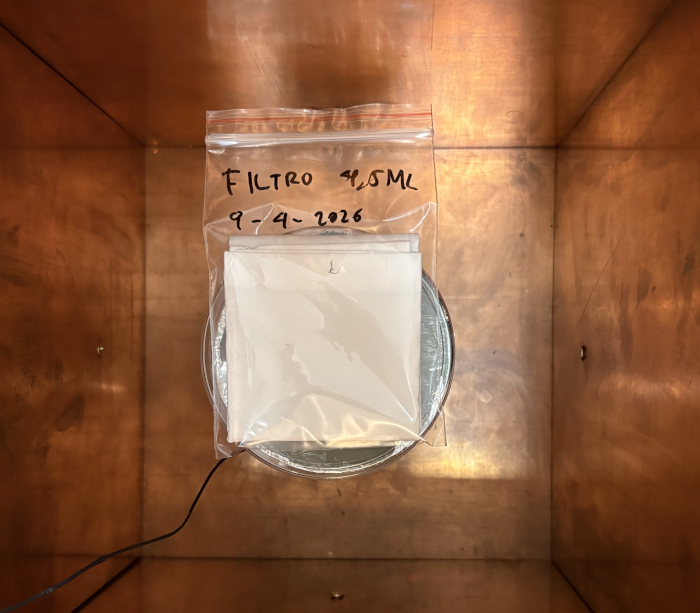
LEMRAP is part of Eyerad, a managed network of INFNs that monitors the airborne environmental radioactivity through a series of stations installed in different sections and laboratories of the Institute. The measurement is done by sampling large volumes of air that is passed through a filter capable of trapping dust particles. At regular intervals, the filters exposed in the LNF's EYERAD environmental station are taken and inserted into a very low-bottom gamma spectrometer designed by LEMRAP. The system is sized to detect very small variations in airborne radioactivity with particular attention to isotopes that could indicate releases of radioactivity into the atmosphere due to radiological or nuclear accidents.
An application-oriented vision
Roberto Bedogni's vision is clear: to carry out high-level scientific research while always keeping an eye on the needs of society; Keeping the idea of research alive curiosity driven, However, while being aware of what the real problems are and what solutions a research organisation such as INFN can provide, it does not distort the main mission of increasing knowledge, but complements it with a commitment to the transfer of technology to society.
Find out more:
If you are interested in the activities of the LEMRAP laboratory, contact us
If you want more information about the DOIN dosimeter, click here
News
Read also
More news from INFN Technology Transfer.
Particle accelerators at the service of society
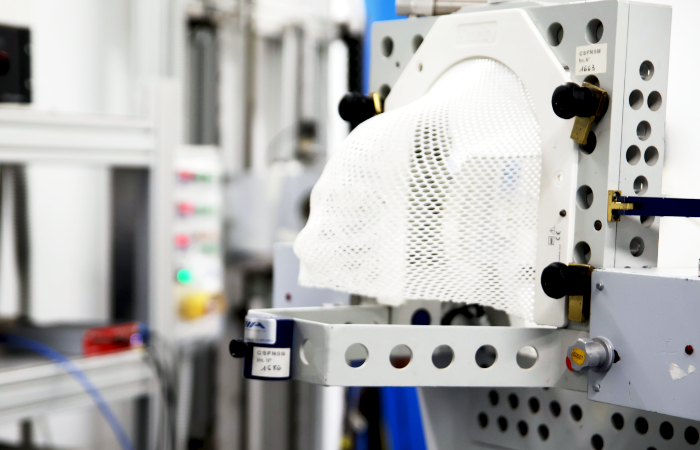
If you think of a particle accelerator, great equipment comes to mind in laboratories dedicated to scientific research. The role of these machines in the study of basic science is certainly very important, however, they are also used for purposes closer to everyday life. Among the different applications of accelerators, the most significant are probably those related to medicine and cancer treatment.
L as Lead
To reach the market, a technology born in the laboratory needs to be accompanied along a path that goes from identifying its application potential to valorisation, through constant monitoring and support. This is the role that the INFN Technology Transfer Service, together with the National Committee for Technology Transfer (CNTT) and the network of local representatives plays every day, that is to act as a lead, a guide, between basic physics and the productive world. Lead is a structured process that connects laboratories, researchers, companies, investors and institutions to transform skills and knowledge into concrete innovation capable of generating value for society.
From Laboratory to Patient: The Role of INFN Technology Transfer in Life Sciences
From laboratory to patient: the role of INFN Technology Transfer in medical physics The point of view of Mariangela Cestelli Guidi, coordinator of INFN's National Committee for Technology Transfer
Contact us
Want to collaborate with INFN?
Tell us about your need: the TT Service puts you in touch with the right people and skills for your project.
Contact us